
Motorcycle Brake Hose Fittings Explained: How to Choose the Correct Connection
Many brake hose problems are not caused by the hose itself. Incorrect fittings, thread specifications, sealing methods or fitting angles can create installation problems and may affect the reliability of the hydraulic connection.
For this reason, anyone buying motorcycle brake lines should pay as much attention to the fittings as to the hose material.
Why Are Brake Hose Fittings So Important?
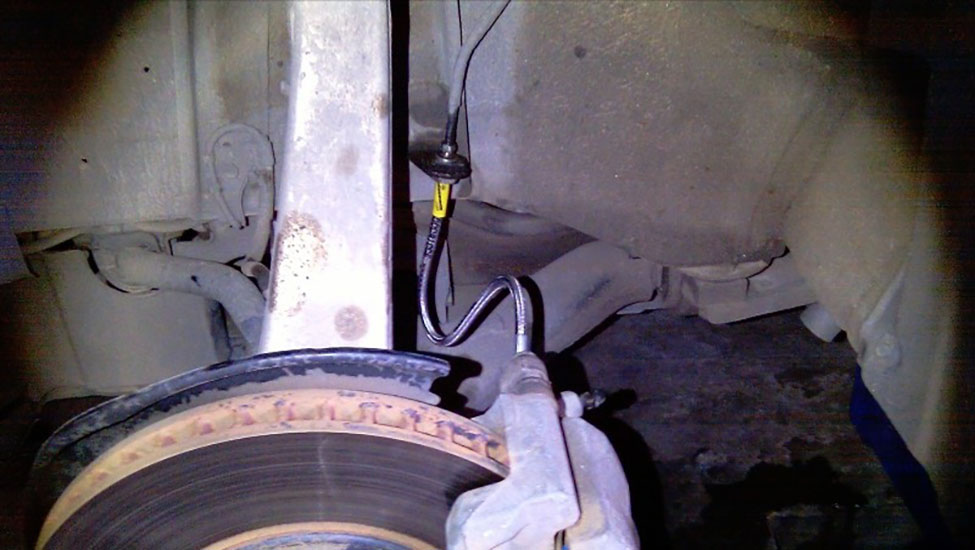
The fitting provides the connection between the flexible brake hose and components such as the master cylinder or brake caliper.
The connection needs to remain secure while handling hydraulic pressure, vibration, temperature changes and continuous motorcycle movement.
A Correct Brake Hose Connection Requires
- Correct thread specification
- Correct fitting design
- Correct sealing method
- Correct fitting angle
- Correct hose assembly
- Correct installation torque according to the application
Check the Thread Before Ordering
One of the most common purchasing mistakes is assuming that two fittings are compatible because they look similar.
Different thread standards can have similar external appearances but are not interchangeable.
Information Buyers Should Confirm
- Thread type
- Thread diameter
- Thread pitch
- Connection style
- Sealing method
For an aftermarket project, the safest approach is to confirm the original fitting specification or provide an existing sample for checking.
Why Does Fitting Angle Matter?
A straight fitting may work on one motorcycle while an angled fitting may be required on another.
The angle affects how the hose leaves the master cylinder or caliper and can make a major difference to final routing.
Avoid Sharp Bends
A brake hose should not be forced into an unnecessarily tight bend immediately after the fitting.
Correct fitting orientation allows the hose to follow a natural route and reduces unnecessary mechanical stress.
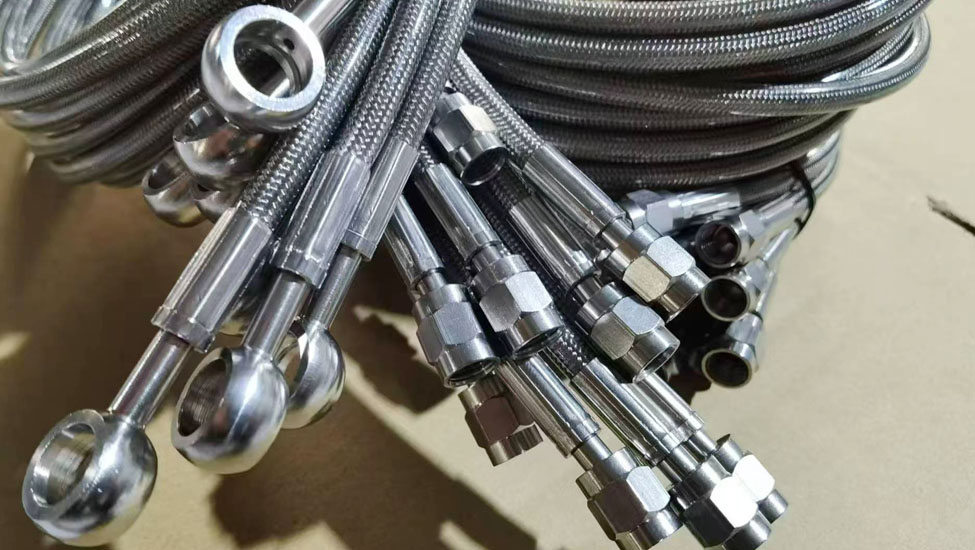
Banjo Fittings and Motorcycle Brake Lines
Banjo-style connections are widely used in motorcycle braking systems because they allow the hose to connect in a compact configuration.
When specifying a banjo connection, buyers should confirm the bolt size, fitting angle and sealing arrangement rather than simply requesting a “banjo fitting.”
Why Samples Are Useful
For distributors and workshops ordering customized brake hoses, sending an original fitting or hose assembly can eliminate uncertainty about dimensions and connection details.
How Hose Length and Fittings Work Together
Correct hose length cannot be determined independently from the fittings.
The effective routing depends on where the fitting starts, its angle and the position of the master cylinder and caliper.
Too Short
A hose that is too short may become tight when the handlebar turns or the suspension moves.
Too Long
Excessive length can create unnecessary loops and increase the chance of contact with other components.
Correct Length
The goal is sufficient movement without excessive slack, sharp bends or mechanical interference.
Fitting Material and Surface Finish
Fitting material and surface treatment are also part of the product specification.
Depending on the application, customers may request different fitting finishes for appearance, corrosion resistance or product matching.
Appearance Is Not the Main Specification
A polished or colored fitting may look attractive on a modified motorcycle, but the correct dimensions and connection specification remain more important.
PTFE and Nylon Brake Hose Assemblies
For projects requiring a complete hose and fitting solution, an assembled brake line can simplify specification and installation.
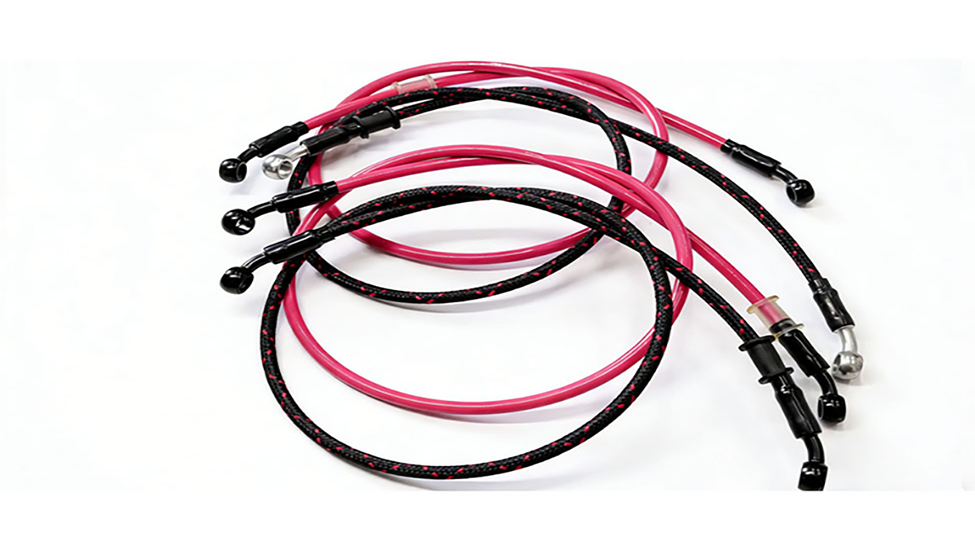
Our PTFE Brake Line Assembly combines the hose construction with the required fitting configuration.
For applications using nylon hose construction, a Nylon Brake Line Assembly can also be specified according to the motorcycle and application.
How to Measure an Existing Motorcycle Brake Hose
Step 1: Measure the Overall Length
Measure the hose according to a consistent reference point. Do not simply measure the straight-line distance between the two components.
Step 2: Record the Fitting Angles
Note the orientation of both ends. Taking photographs from several angles can help avoid mistakes.
Step 3: Identify the Threads
Record the thread size and pitch where possible.
Step 4: Record the Hose Routing
Take photographs with the handlebar straight and turned to both sides. This is especially useful for front brake lines.
Common Brake Hose Purchasing Mistakes
Ordering by Motorcycle Model Only
Model information is useful, but modified motorcycles may no longer use the original master cylinder, caliper or handlebar configuration.
Ignoring Fitting Orientation
Two hoses with the same length may require different fitting angles.
Using an Unverified Thread Specification
Never assume a fitting is compatible because it can be physically inserted. Thread and sealing specifications must match.
Maintenance After Brake Hose Installation
After installation, inspect the fittings and hose routing carefully.
- Check connections for leakage.
- Confirm the hose is not twisted.
- Check full steering movement.
- Make sure the hose does not rub against sharp edges.
- Inspect routing after suspension or handlebar work.
Our Custom Motorcycle Brake Hose Service
We manufacture customized motorcycle brake hoses and assemblies for aftermarket, replacement and modification projects.
Customers can provide an original hose, technical drawing, dimensions or photographs. Hose length, material, fitting type and fitting angle can then be reviewed before production.
For Workshops and Distributors
If you are developing a motorcycle brake line range or need a repeatable specification for multiple models, we can work from samples and drawings to establish the required assembly configuration.
Contact Us for Custom Brake Hose Fittings and Assemblies
FAQ About Motorcycle Brake Hose Fittings
How do I know which brake hose fitting I need?
Confirm the thread, connection style, fitting angle and sealing method. An original hose or fitting sample is often the most reliable reference.
Can I use a different fitting angle?
Only if the resulting routing remains safe and compatible with the motorcycle. The hose must not become stretched, twisted or trapped during steering and suspension movement.
Can you make brake hoses according to a drawing?
Yes. A technical drawing can provide useful information about hose length, fitting positions and dimensions. An original sample can also be used as a reference.
Does a longer brake hose improve braking performance?
No. Hose length should be appropriate for the motorcycle's routing requirements. Excessive length does not provide a performance advantage.