How to Choose the Right Motorcycle Brake Line for an Upgrade
Choosing a motorcycle brake line should start with the brake system, not the appearance of the hose. Length, fittings, inner tube material, reinforcement, routing and brake fluid compatibility all need to be considered before ordering.
This is especially important for modified motorcycles. Once the original handlebars, master cylinder, caliper or suspension have been changed, the factory brake hose may no longer have the correct dimensions or routing.
1. Identify the Motorcycle Brake System
First determine whether the hose is for the front brake, rear brake or another hydraulic application. Then identify the master cylinder and caliper connection points.
Information Useful for a Custom Order
- Motorcycle model
- Front or rear application
- Master cylinder information
- Caliper information
- Original hose length
- Fitting specifications
- Required fitting angles
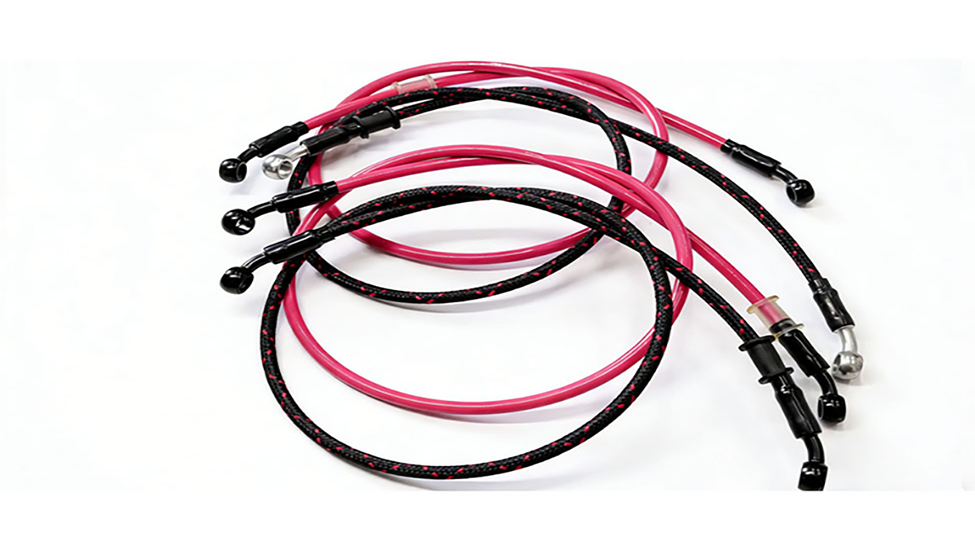
- Required hose color
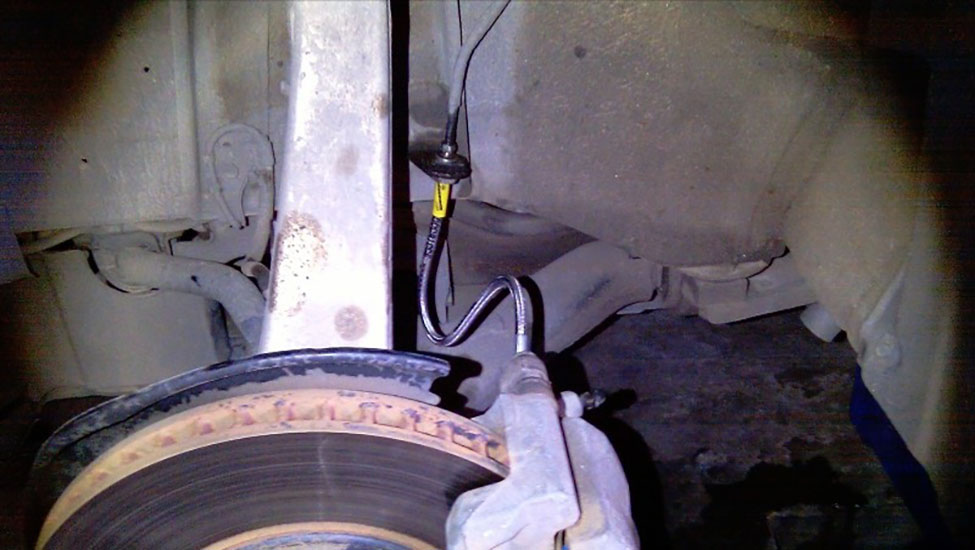
2. Measure the Existing Brake Hose
If the original brake hose is available, use it as a reference rather than estimating the length from the motorcycle model.
Measure the complete hose assembly and record the position of both fittings. If the motorcycle has already been modified, measure the actual routing that will be used after the modification.
Why Length Alone Is Not Enough
A 500 mm hose with one fitting orientation may not be interchangeable with another 500 mm hose using a different fitting configuration.
The fitting angle and end orientation are part of the finished product specification.
3. Choose Between PTFE, Nylon and Rubber Constructions
Different materials are used for different brake hose requirements.
PTFE is commonly used in performance-oriented hydraulic brake hose assemblies because of its chemical resistance and dimensional characteristics.
Our Teflon Brake Line products can be considered for applications requiring a Teflon/PTFE inner tube construction.
For nylon-based applications, the Nylon Brake Line is another option.
For conventional applications, Rubber Brake Line Assembly products remain widely used.
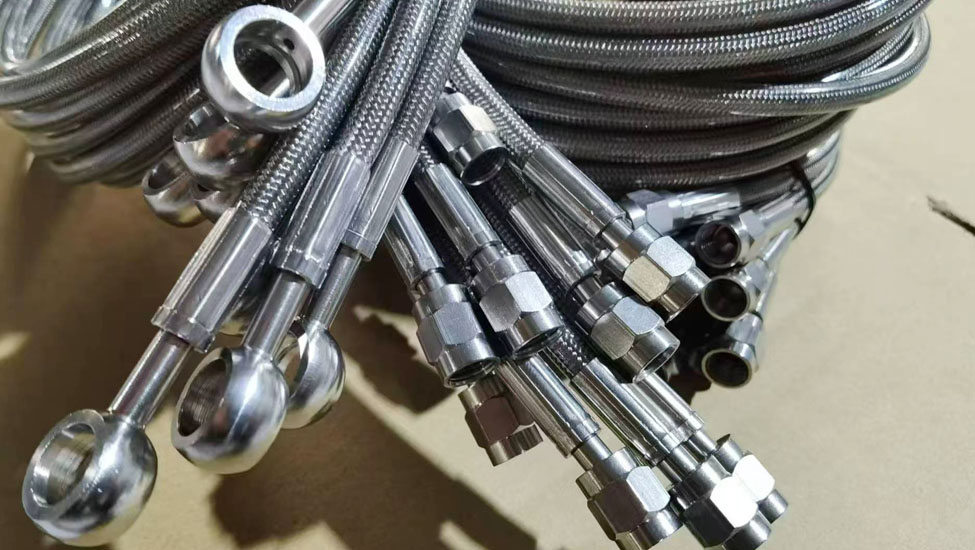
4. Understand Braided Brake Line Construction
A stainless steel braided hose generally uses reinforcement around an inner tube. The reinforcement helps provide mechanical strength while allowing the hose to remain flexible enough for vehicle installation.
The final assembly also depends on the fittings and crimping process. It is therefore not appropriate to judge a brake hose only by the visible braid.
Important Construction Factors
- Inner tube material
- Reinforcement material
- Braid construction
- Outer protective layer
- Fitting material
- Crimping method
5. Check Brake Fluid Compatibility
The inner tube must be compatible with the brake fluid specified for the application.
Do not assume that all hydraulic hoses are interchangeable simply because they have similar dimensions. Material compatibility should be confirmed with the hose manufacturer and vehicle or brake component specifications.
6. Consider Heat and Routing
Motorcycle brake hoses can pass close to the engine, exhaust system, fork and other components. The routing needs to provide adequate clearance and avoid unnecessary bending or abrasion.
Installation Checklist
- Check full handlebar movement.
- Check suspension movement where applicable.
- Avoid sharp bends.
- Avoid twisting the hose.
- Keep the hose away from hot components.
- Prevent continuous rubbing against brackets.
7. When Is a PTFE Brake Line Assembly a Good Choice?
A PTFE brake line assembly can be considered when the application requires a PTFE inner tube together with suitable reinforcement and fittings.
Our PTFE Brake Line Assembly products can be developed for specific hose length, fitting and assembly requirements.
The final specification should still be confirmed according to the actual motorcycle and hydraulic system.
8. Motorcycle Brake Hose Upgrade for Different Markets
Different overseas markets can have different aftermarket preferences. Motorcycle parts distributors may require several hose lengths, colors and fitting configurations for the same basic product range.
This is why custom production can be useful for importers and modification shops rather than relying only on universal kits.
9. What Should a Distributor Ask a Brake Hose Factory?
- What inner tube material is used?
- What reinforcement is used?
- What fittings are available?
- Can hose length be customized?
- Can fitting angles be customized?
- Can samples be produced before bulk orders?
- Can packaging and labels be customized?
- Can the same specification be reproduced for repeat orders?
10. Maintenance After Installation
Inspect the brake hose regularly, particularly after motorcycle modifications.
- Check for leakage.
- Inspect the fittings.
- Check the hose for abrasion.
- Inspect areas close to moving parts.
- Check the routing after suspension or handlebar changes.
11. FAQ
How often should motorcycle brake hoses be replaced?
Replacement should follow the manufacturer's maintenance recommendations and the actual condition of the hose. There is no single replacement period suitable for every motorcycle.
Does upgrading to braided brake lines really improve safety?
A suitable braided brake line may offer different reinforcement and expansion characteristics compared with some conventional hoses. However, braking safety depends on the entire system and correct installation.
Can one brake line fit all motorcycles?
No. Different motorcycles can use different hose lengths, fittings, threads, angles and routing configurations.
Can I send a drawing or sample to the manufacturer?
Yes. A drawing or sample is often the most efficient way to communicate custom hose requirements.
12. Custom Motorcycle Brake Line Manufacturing
For aftermarket and OEM projects, we can work from drawings, existing hose samples and technical specifications. Custom requirements can include hose construction, length, fittings, fitting orientation and packaging.