Beyond the Garage- How Climate Driving Conditions Accelerate Brake Line Leaks
2026-5-22
Comments
Beyond the Garage: How Climate and Driving Conditions Accelerate Brake Line Leaks
The Hidden Enemies of Your Brake Hydraulics: Salt, Heat, and Vibration
In coastal areas of Japan and Korea, road salt is a major aggressor. In the Middle East, it's relentless UV exposure and sand abrasion. In Southeast Asia, it's constant humidity and temperature swings. These environmental factors don't just make your car dirty – they systematically attack the weakest point in many brake systems: the flexible brake hoses. Understanding this allows you to choose a hose not just to stop a leak, but to prevent the next one.
Material Breakdown: Why Rubber Fails and Synthetics Prevail
Standard Rubber Brake Line Assembly is a composite of synthetic rubber layers and fabric reinforcement. Here’s how the environment breaks it down:
- UV Radiation & Ozone: Causes the outer rubber layer to harden, crack, and become brittle (a condition called “weather checking”). These micro-cracks eventually penetrate, allowing fluid to seep out.
- Salt & Moisture: Promotes corrosion on the metal end fittings and the internal reinforcement wires of the hose. This corrosion can work its way from the inside out, leading to a sudden rupture.
- Heat Cycling: Repeated heating from the brakes and cooling causes the rubber to lose its elasticity over time. It becomes hard and less able to absorb vibrations, transferring more stress to the fittings, which can loosen and leak.
The Performance Upgrade: A Layer-by-Layer Defense
This is where the engineering of aftermarket lines makes a tangible difference. Let's compare:
- Inner Liner: We replace the degradable rubber with Nylon or PTFE. These materials are chemically inert, non-absorbent, and have a much wider operating temperature range, eliminating the internal degradation that weakens the hose from within.
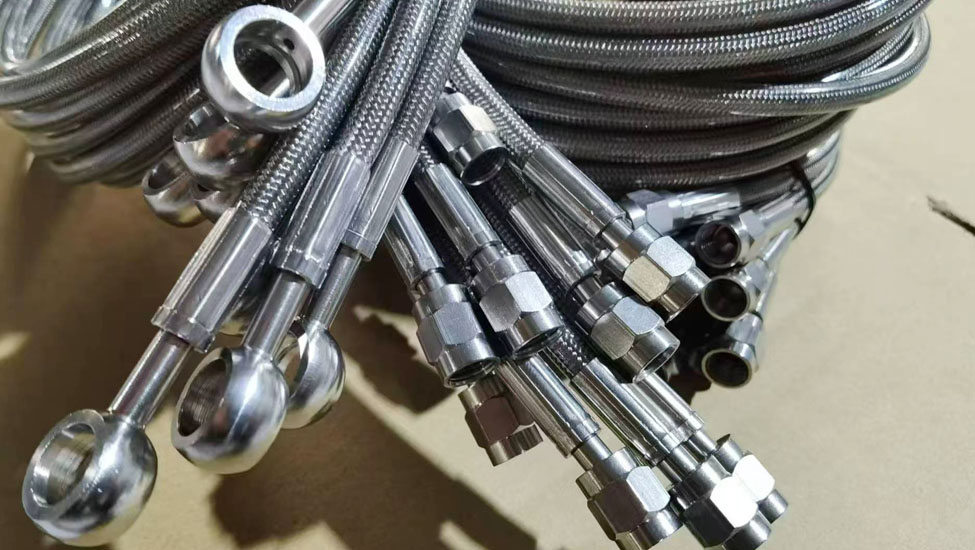
- Reinforcement: Instead of fabric, we use a tightly woven, 304-grade stainless steel braid. This provides immense tensile strength and acts as a near-impenetrable barrier against external physical damage.
- Outer Jacket: A specialized polymer jacket covers the steel braid, providing additional protection against UV, oils, and chemicals.
This construction makes a full PTFE Brake Line Assembly not just a hose, but a sealed, armored conduit for your brake fluid.
Buyer's Guide: What International Customers Should Prioritize
From our work with clients worldwide, here’s what matters most:
- Japanese/Korean Tuners: Demand exact OEM fitment and clean aesthetics. Our vehicle-specific kits ensure perfect length and routing.
- Middle Eastern Off-Roaders: Prioritize extreme heat and abrasion resistance. The stainless steel braid is crucial here.
- Southeast Asian Daily Drivers: Value resistance to constant humidity and reliable performance. Nylon Brake Lines offer an excellent balance of durability and value in these conditions.
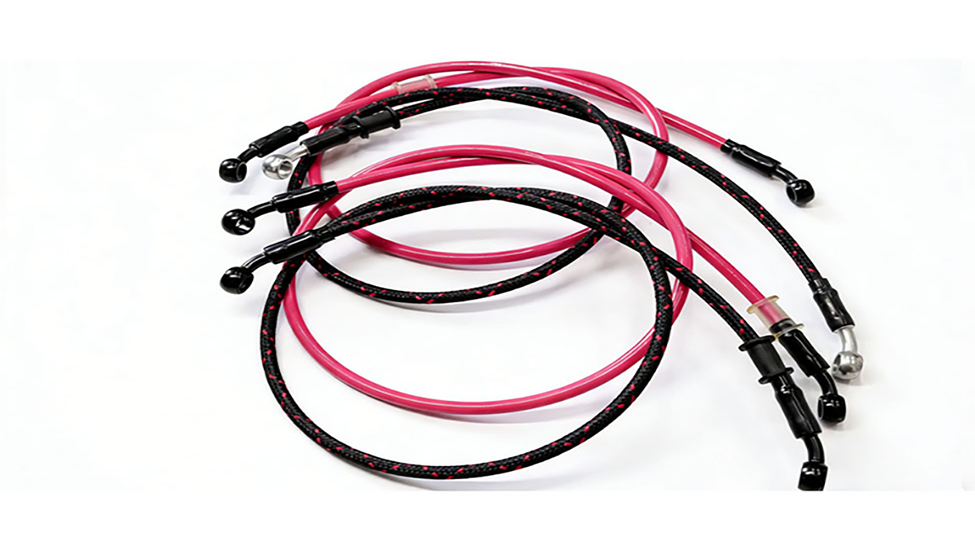
Our Core Product Range for Leak Prevention: We specialize in Teflon (PTFE) Brake Lines, Nylon Brake Lines, and complete, ready-to-install Nylon Brake Line Assembly kits for a wide range of vehicles.
FAQ: Compatibility and Custom Solutions
- Q: Are these upgraded hoses suitable for all vehicle models? A: We provide solutions for most applications. We offer both popular vehicle-specific kits and support full custom manufacturing. Leveraging data from multiple vehicle models and an intelligent adaptation system, we can quickly provide OEM-level replacement solutions. If you have a rare or modified vehicle, simply contact us with your图纸 or specifications.
- Q: What about the banjo bolt washers? Do I need new ones? A: Always use new copper sealing washers. Reusing old, crushed washers is a primary cause of leaks at the fitting. Our kits include all necessary, high-quality hardware.